
The consequences of Corona over world economyhttps://www.worldbank.org/en/news/feature/2020/06/08/the-global-economic-outlook-during-the-covid-19-pandemic-a-changed-worldThe Global Economic Outlook During the COVID-19 Pandemic ...

 The consequences of Corona over world economy

Its spread has left national economies and businesses counting the costs, as governments struggle with new lockdown measures to tackle the spread of the virus.

Despite the development of new vaccines, many are still wondering what recovery could look like.

Here is a selection of charts and maps to help you understand the economic impact of the virus so far.

Global shares in flux

Big shifts in stock markets, where shares in companies are bought and sold, can affect the value of pensions or individual savings accounts (Isas).

The FTSE, Dow Jones Industrial Average and the Nikkei all saw huge falls as the number of Covid-19 cases grew in the first months of the crisis.

The major Asian and US stock markets have recovered following the announcement of the first vaccine in November, but the FTSE is still in negative territory.

The FTSE dropped 14.3% in 2020, its worst performance since 2008.
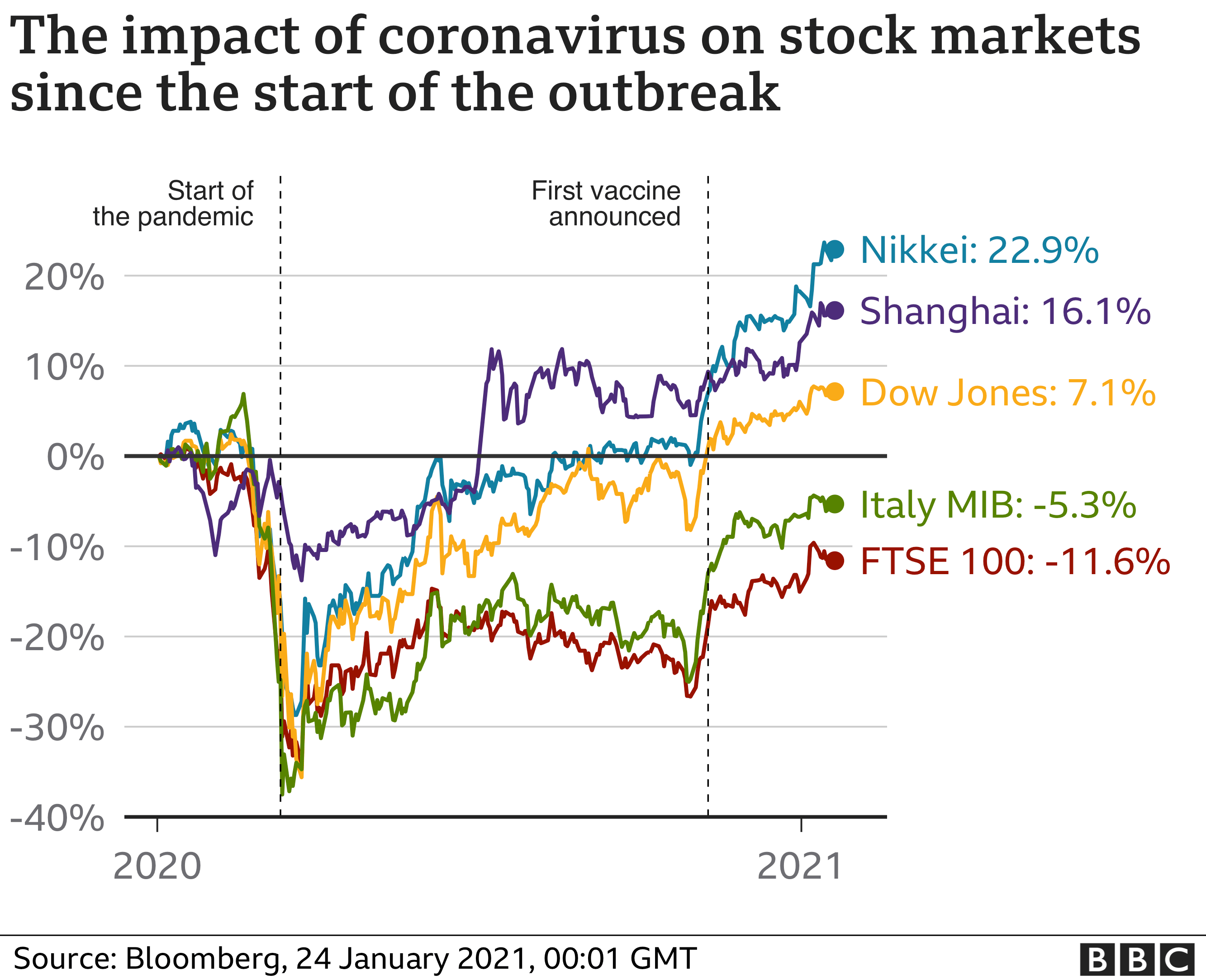
Stock market chart - Jan 2021

In response, central banks in many countries, including the UK, have slashed interest rates. That should, in theory, make borrowing cheaper and encourage spending to boost the economy.

Some markets recovered ground in January this year, but this is a normal tendency known as the "January effect".

Analysts are worried that the possibility of further lockdowns and delays in vaccination programmes might trigger more market volatility this year.

A difficult year for job seekers

Many people have lost their jobs or seen their incomes cut.

Unemployment rates have increased across major economies.
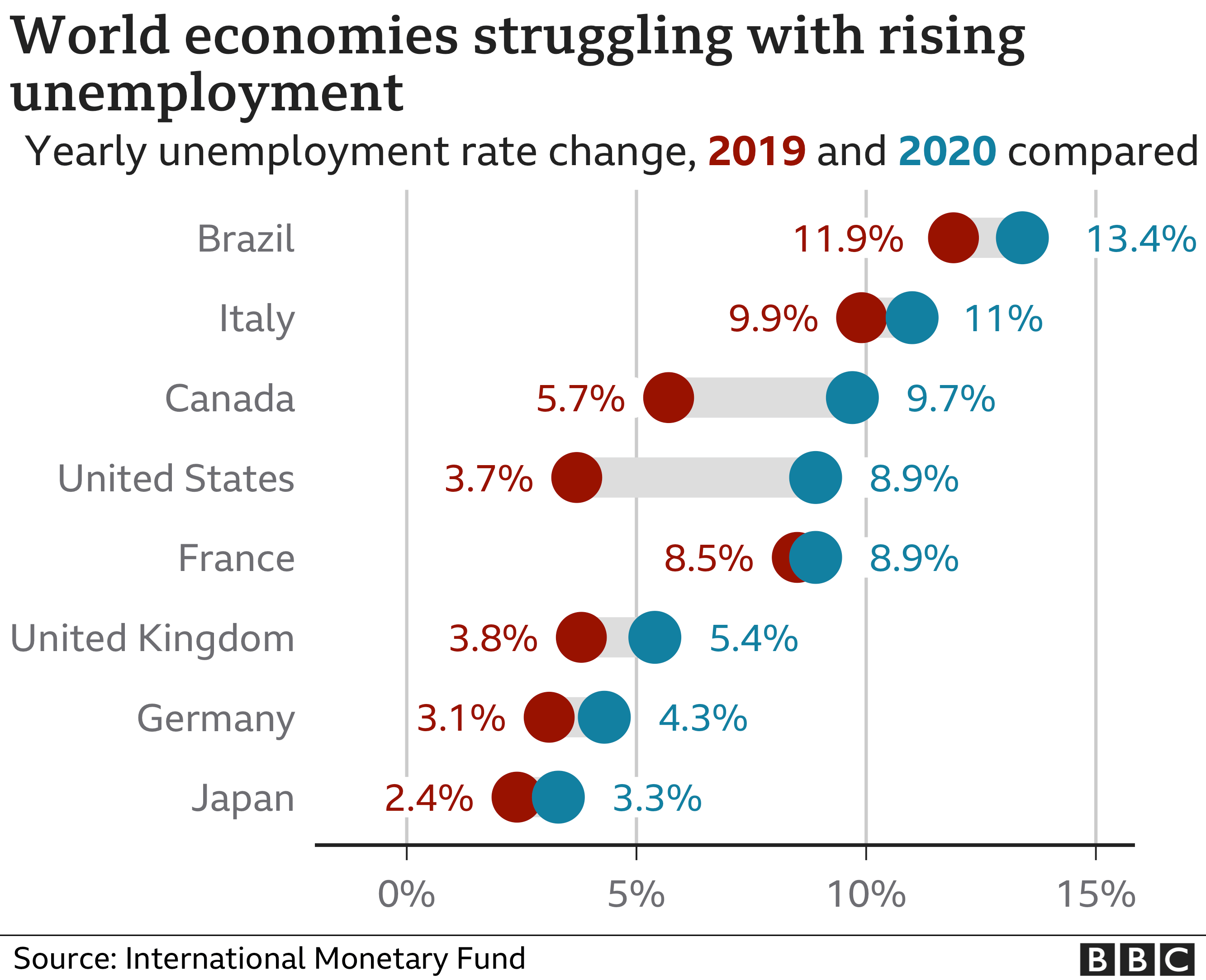
Unemployment rate chart - Jan 2021

In the United States, the proportion of people out of work hit a yearly total of 8.9%, according to the International Monetary Fund (IMF), signalling an end to a decade of jobs expansion.

Millions of workers have also been put on government-supported job retention schemes as parts of the economy, such as tourism and hospitality, have come to a near standstill.

The numbers of new job opportunities is still very low in many countries.

Job vacancies in Australia have returned to the same level of 2019, but they are lagging in France, Spain, the UK and several other countries.

Comments

Popular posts from this blog

How long will the Corona last

  How the Pandemic Will End The U.S. may end up with the worst COVID-19 outbreak in the industrialized world. This is how it’s going to play out. Joan Wong Story by  Ed Yong MARCH 25, 2020 HEALTH Like  ​The Atlantic ? Subscribe to  ​ The Atlantic Daily​ , our free weekday email newsletter. Editor’s Note:   The Atlantic  is making vital coverage of the coronavirus available to all readers. Find the collection  here . T hree months ago , no one knew that SARS-CoV-2 existed. Now the virus has spread to almost every country, infecting at least 446,000 people whom we know about, and many more whom we do not. It has crashed economies and broken health-care systems, filled hospitals and emptied public spaces. It has separated people from their workplaces and their friends. It has disrupted modern society on a scale that most living people have never witnessed. Soon, most everyone in the United States will know someone who has been infected. Like World War II ...

How to motivate to get success

  there’s one thing I’ve learned from   being self-employed as a writer , it’s that motivation is a complex and fickle beast. Some days, I’m in a groove—I can crank out articles left and right, only taking a quick break to refill my coffee or eat lunch. Other days, I have to force myself not to surf Reddit and run unimportant errands. When motivation has to be intrinsic (meaning there’s no boss breathing down your neck to get things done), it can be harder to come by. Below, you’ll find a series of research-backed tips and tricks that entrepreneurs swear by when they’re stuck:1-To make strategy for success This is my go-to strategy. Over the past few years, I’ve identified the times when I’m most productive: 7:30 a.m. to 2 p.m., Monday through Thursday. I make sure to schedule the work that requires the most focus during these windows. I’ll never leave an article that’s due on a Monday morning, for example, for Friday afternoon because I know it’s unlikely I’ll muster the ment...

To make the children motivated for the studies

  Your Children to Do Well in School Updated on May 6, 2021 By  Daniel Wong   27 Comments Do you have trouble motivating your children to study? It’s a common problem that I see in my  coaching work with pre-teens and teens . I notice that many parents approach this problem in the wrong way. In this article, I’m going to explain 10 principles for motivating children to do well in school. FREE BONUS ​ Enter your email below to download a PDF summary of this article. The PDF contains all the tips found here, plus  3  exclusive bonus tips  that you’ll only find in the PDF. SEND ME THE PDF! 1. Don’t annoy your children One of the keys to motivating your children to work hard is not to annoy them. This may seem odd at first, as we’re used to parents getting annoyed with children, not vice versa. But relationships are a two-way street, and parents can also annoy children. If your children are continually upset with you over things you say or do, they will fi...